


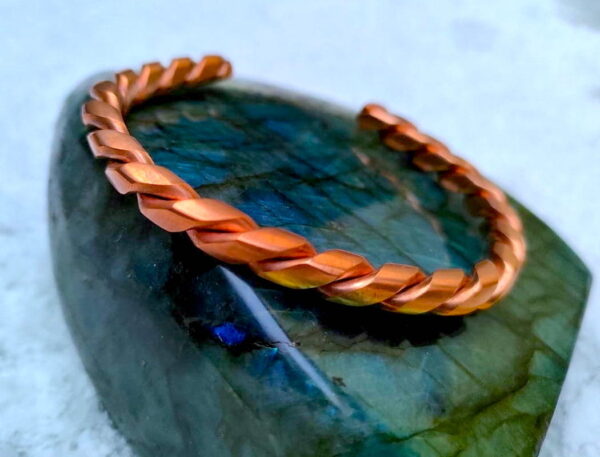
Tensor rings: what are they? A tensor ring is a closed loop of tightly twisted wire, usually copper, cut to a length derived from the ancient Egyptian royal cubit (about 52.4 cm or 20.6 inches) and joined end to end. It is not jewelry in the ordinary sense, even when it is worn as a bracelet. Makers and users describe it as a tool that shapes subtle energy. One distinction matters most. The object itself is simple to describe, and its craft can be checked: wire, twist, length, closure. The energetic explanation behind it comes from a modern alternative tradition and has not been confirmed by mainstream physics. Holding those two layers apart is the clearest way to understand what you are looking at.
What is a tensor ring made of, physically?
Strip away the vocabulary and a tensor ring has four measurable features:
- Material. Most rings use copper wire. Some makers twist two or more strands together, and a few use silver or gold plating over copper.
- Twist. The strands are wound into a tight, even helix, a little like a cable. Makers treat the evenness of the twist as a sign of careful work.
- Length. The wire is cut to the full royal cubit or to a set fraction or multiple of it. Common listings refer to a "1 cubit" ring, a "half cubit" ring, or bracelet sizes built from cubit fractions.
- Closure. The ends are joined so the loop is continuous. In the tradition the closed loop is the whole point, so a ring with a gap is usually treated as a different object.
This means two rings that look similar may differ in the details that matter to the people who make them. A careful listing will tell you the wire, the twist, and the cubit fraction the ring is built on.
Where did the idea of tensor rings come from?
The modern tensor ring traces back to Slim Spurling (1938 to 2007), an American inventor based in Colorado. From the 1980s onward he made and distributed what he called "Light-Life" rings and related tools, and he described them as devices that organize energy into a self-sustaining field. Spurling was not trained as a physicist. His work belongs to a lineage of independent researchers and dowsers who built tools by experiment and personal observation, then explained them in their own terms.
Spurling tied his ring lengths to the royal cubit, the standard measure used by ancient Egyptian builders. Archaeologists have recovered cubit rods and studied pyramid dimensions, and the royal cubit is generally put at roughly 52.3 to 52.5 cm. That measurement is real and well documented. The idea that this particular length gives a wire loop special energetic properties is Spurling's own proposal, not something drawn from Egyptian texts or practice.
What is a "torsion field," and is it real physics?
Many descriptions of tensor rings say they produce or channel a "torsion field." The term has two very different lives, and confusing them is where most marketing goes wrong.
Torsion in mainstream physics
In general relativity, "torsion" is a precise mathematical property of spacetime geometry. The Einstein-Cartan theory, reviewed in detail by Friedrich Hehl and colleagues in 1976, allows spacetime torsion linked to the spin of matter. In that theory the effects are confined to extreme densities, such as those in the very early universe, and they have no practical influence at the scale of everyday objects. Nothing in this framework describes a copper ring.
Torsion fields in alternative research
A second use of the term grew out of Soviet and Russian research. The astrophysicist Nikolai Kozyrev (1908 to 1983) proposed a theory he called "causal mechanics," in which time itself carries active properties, and he reported experiments he believed supported it. In the 1990s, researchers including Anatoly Akimov and Gennady Shipov promoted "torsion fields" as a new kind of field that could pass through matter and carry information. These claims were sharply criticized. The Russian Academy of Sciences' Commission for Combating Pseudoscience, founded in 1998, singled out torsion field research as an example of work that did not meet scientific standards, and independent replication has not appeared in the physics literature.
So here is the plain answer. "Torsion field" as used in tensor ring literature is a concept from alternative research, not an established physical field. Earlier writing that presents it as proven science, or that ties it to cell growth or bodily cycles, goes well beyond the evidence. You can respect a practice and still be honest about this.
How do people use tensor rings in practice?
Users describe tensor rings in experiential terms: a sense of focus, steadiness, or attention. These are personal reports, not measured effects, and a tensor ring is not a treatment for any condition. With that framing, the common traditions of use look like this:
- On the altar or ritual table. Some practitioners lay a ring at the center of a ceremonial space, sometimes with a candle, a stone, or ceremonial tools set inside it. The loop works as a visible boundary, a way of saying "this space is set apart."
- Beneath a vessel. A widespread custom places a glass or pitcher of water inside or on top of a ring. Users describe this as "charging" or "structuring" water. That is a belief within the practice, not a demonstrated change in the water.
- Worn on the body. Bracelet and anklet versions are worn during meditation, breathwork, or simply through the day as a reminder of intention.
- Held during meditation. Larger rings are sometimes held in the lap or hands, where the even twist of the wire gives the fingers something steady to rest on.
What these uses share is less a mechanism than a gesture. A closed circle is one of the oldest symbols people use for wholeness and protection, and a tensor ring gives that symbol a precise, handmade form.
How are tensor rings different from copper bracelets and other ritual circles?
It helps to place the tensor ring next to similar objects:
- Ordinary copper bracelets are usually open cuffs of solid metal, sold for their look or for folk beliefs about copper. Tensor rings are twisted, closed, and cut to a specific length. The maker's intent is different.
- Magnetic bracelets contain magnets. A copper tensor ring is not magnetic, and copper does not hold a magnetic field on its own. Descriptions claiming a ring "creates its own magnetic field" are inaccurate.
- Traditional ceremonial circles, such as stone circles, medicine wheels, or ring-shaped offerings in many cultures, come out of long community lineages. The tensor ring is a late twentieth century invention. It can sit respectfully beside older traditions, but it does not belong to any Indigenous heritage, and honest sellers do not present it that way.
What should you look for when choosing a tensor ring?
Since the claims cannot be tested at home, judge the craft. These questions separate careful work from mass production:
- Is the cubit fraction stated? A good listing names the length the ring is built on, not just "small" or "large."
- Is the twist even? Look at photos for consistent spacing along the whole loop, with no loose sections or flattened spots.
- How is it closed? The join should be clean and secure. A rough or sharp join can catch skin and clothing.
- What metal, exactly? Bare copper, coated copper, or plated wire should be named. Bare copper darkens over time, and some people see a faint green mark on skin from copper contact. This is normal and harmless for most people, but worth knowing.
- Does the seller avoid health promises? Language about curing pain, inflammation, or illness is a warning sign about the seller, not a feature of the ring.
How do you care for a tensor ring as an object?
Care is simple. Copper oxidizes naturally into a brown or reddish tone. Some owners like the aged look; others restore the shine with a soft cloth and a mild copper cleaner or a little lemon juice and salt, followed by rinsing and thorough drying. Store rings flat or hung so the loop keeps its shape, away from damp spaces. Avoid bending or reshaping the circle, since kinks loosen the twist over time.
If you keep a ceremonial space, a ring can live there alongside other tools, kept dry and handled with the same attention you give to anything you treat as meaningful. You can explore our ceremonial tools and ritual objects at Rapé Shop, where we describe what each item is, where it comes from, and what is and is not claimed about it.
So, tensor rings: what are they, in one sentence?
They are carefully made loops of twisted copper, sized by an ancient Egyptian measure and invented in their modern form by Slim Spurling, used today as personal and ritual objects whose energetic explanation rests on alternative research rather than established science. Approached with that clarity, a tensor ring can be a meaningful part of a grounding practice without asking you to believe more than the evidence supports.
In shop practice, anchor the habit in concrete products: RA-MU Cubit tensor ring, RA-MU Cubit tensor bracelet, Viking Cubit tensor bracelet. Compare labels in the same language and product form.
Sources
- Hehl, F. W., von der Heyde, P., Kerlick, G. D., and Nester, J. M. (1976). "General relativity with spin and torsion: Foundations and prospects." Reviews of Modern Physics 48, 393.
- Kozyrev, N. A. (1971). "On the possibility of experimental investigation of the properties of time." English translation in Time in Science and Philosophy, Prague: Academia.
- Arnold, D. (1991). Building in Egypt: Pharaonic Stone Masonry. Oxford University Press. (On the royal cubit and Egyptian building measures.)
- Kruglyakov, E. P. and the Russian Academy of Sciences Commission for Combating Pseudoscience and Falsification of Scientific Research (founded 1998), published critiques of torsion field research, late 1990s to 2000s.
- Spurling, S. Light-Life Technology materials and workshop booklets (1980s to 2000s), primary source for the tensor ring concept as described by its originator.