


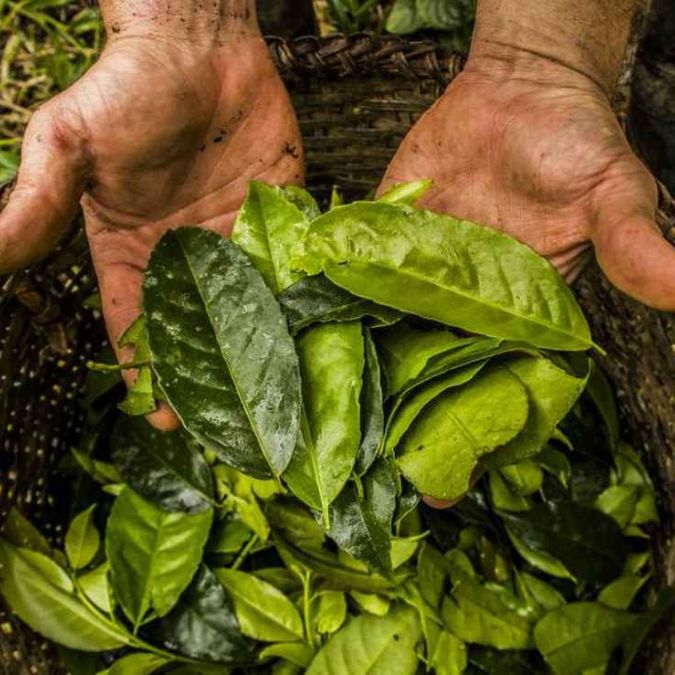
Guayusa is a tea brewed from the leaves of Ilex guayusa, a holly tree native to the upper Amazon, mainly Ecuador. It contains caffeine. It is a close botanical cousin of yerba mate, but it tastes noticeably smoother. Most people only know guayusa as a bottled energy drink. The leaf has a much older life as the center of a pre-dawn social ritual among the Kichwa and Achuar peoples. That ritual is what makes Guayusa - The Extraordinary Tea more than a coffee substitute, and this article explains it plainly.
What is guayusa, botanically speaking?
Ilex guayusa Loes. belongs to the Aquifoliaceae, the holly family. Its best-known relatives are Ilex paraguariensis (yerba mate) from the Paraná basin and Ilex vomitoria (yaupon) from the southeastern United States. These three are the only hollies widely known to accumulate meaningful amounts of caffeine in their leaves. Guayusa leaves also contain theobromine, the compound associated with cacao, along with a range of polyphenols such as chlorogenic acids.
The tree grows as an understory species in humid lowland and foothill forest, roughly from southern Colombia through Ecuador into northern Peru. Ecuador's Napo, Pastaza, and Sucumbíos provinces are the heartland. Guayusa rarely sets viable seed in cultivation, so communities have propagated it from cuttings for generations. Botanists read this as a sign of very long human tending.
How old is the guayusa tradition?
The leaf's history reaches far beyond Amazonia. In the 1970s, the ethnobotanist Richard Evans Schultes described guayusa leaves found in a medicine bundle buried with a healer at Niño Korin, a highland site in Bolivia dated to roughly 500 CE. The site lies hundreds of kilometers from where the tree grows. That means the leaf was valued enough to travel along long-distance trade routes. Spanish colonial records later mention Jesuit missions in the Amazon trading guayusa. One account notes a plantation attempt in the region before the order's expulsion in the 1760s.
What happens at the guayusa gathering before dawn?
The most distinctive part of guayusa culture is when people drink it. Among the Napo Runa (Amazonian Kichwa), families traditionally rise around three or four in the morning. They gather around the fire while a large pot of leaves simmers. In Kichwa this gathering is often called wayusa upina, roughly "guayusa drinking."
The hours before sunrise have a clear social purpose:
- Dream interpretation. Family members share the night's dreams, and elders read them as signs for hunting, travel, or family matters.
- Teaching and storytelling. Myths, songs, and practical knowledge pass from older to younger generations while the household is awake together.
- Planning the day. Work in the forest garden, fishing trips, and visits are discussed before the heat of the day sets in.
Guayusa's popular nickname, the "night watchman," comes from this context. It is often linked to hunters who were said to drink it to stay alert through the night. Read it as a cultural story about wakefulness, not a product claim.
The neighboring Achuar, a Jivaroan-speaking people of the Ecuador-Peru borderlands, also hold a dawn guayusa custom with one notable difference. A 1991 study by Walter Lewis and colleagues in the Journal of Ethnopharmacology documented that Achuar men drank large volumes of strong guayusa before dawn and then induced vomiting. They understood this as a morning purification. The researchers measured caffeine in participants and found that most of it was expelled, which helps explain how such quantities were tolerated. The Kichwa gathering, by contrast, is generally a calmer, conversational affair. Both are living practices of specific peoples, not templates to borrow.
How does guayusa compare with yerba mate, coffee, and yaupon?
Guayusa is often called "Ecuador's yerba mate," which is fair botanically and misleading in the cup. Here is how they differ in practice:
- Yerba mate (Ilex paraguariensis) is usually more astringent and grassy. The leaf is often fire-dried or smoked, and it is traditionally shared from a gourd through a bombilla in Argentina, Uruguay, Paraguay, and southern Brazil.
- Guayusa is typically air-dried or low-heat dried. It brews softer, with lower perceived bitterness. Many drinkers describe it as smooth, slightly sweet, and earthy.
- Yaupon (Ilex vomitoria) is North America's native caffeinated holly. The Muscogee and other Southeastern peoples once prepared it as the ceremonial "black drink." It is light and tea-like.
- Coffee comes from an unrelated plant family (Rubiaceae). It contains no theobromine in meaningful amounts, and its roasting gives it a completely different flavor chemistry.
Caffeine content in guayusa varies with leaf age, drying, and brewing strength. Published analyses place the dried leaf in a similar range to other caffeinated hollies. A strong cup can approach the caffeine of a cup of coffee. Claims that guayusa gives "crash-free" energy are marketing shorthand. Caffeine is caffeine, and how it feels depends on the person and the amount.
What does guayusa taste like, and how is it traditionally brewed?
Brewed from whole or cut leaf, guayusa is mellow, slightly vegetal, and faintly sweet. It has an earthy depth that some compare to a light green tea crossed with a soft black tea. Powdered guayusa is stronger and more concentrated, with a cloudier cup.
In Kichwa households the leaves are traditionally simmered in a large pot for a long time, sometimes more than an hour. The result is a strong brew that is shared through the morning. Outside Amazonia, most people steep cut leaf in hot water, much as they would any herbal tea. It also works well cold-brewed. Because guayusa is low in harsh tannins, it tolerates longer steeping without turning bitter as quickly as black tea does.
Who should be cautious with guayusa?
Guayusa is a food and beverage plant, not a remedy, and it is not a substitute for medical care. Its caffeine is the main consideration. People who are sensitive to caffeine, pregnant or breastfeeding, managing heart rhythm or blood pressure concerns, or taking medicines that interact with stimulants should treat it as they would coffee. Speaking with a qualified health professional first is sensible. Late-day cups may interfere with sleep, which fits neatly with the "night watchman" story.
On the regulatory side, dried guayusa leaf infusion was assessed in the European Union under the novel food framework (Regulation (EU) 2015/2283) as a traditional food from a third country. The basis was its documented history of safe use as a beverage in Ecuador. This is about a brewed tea for drinking. It says nothing about therapeutic benefit.
Why is guayusa different from rapé and other ceremonial preparations?
Our shop also deals in Amazonian ceremonial objects, so this distinction matters. Guayusa is a beverage, drunk as tea. Preparations such as rapé (hapé), ambil, and chilcambil belong to entirely different traditions. They are sold as cultural and ethnobotanical items and are not for consumption. They come from different plants and peoples and should never be treated as interchangeable with a tea. Guayusa's place in Amazonian life is domestic and social: a pot on the fire, a family awake before the birds.
How can you recognize well-sourced guayusa?
Since the 2010s, demand for guayusa has grown quickly. Much of the leaf on the market still comes from small Kichwa growers in Napo province. They raise it in chakras, traditional agroforestry gardens where guayusa grows alongside cacao, plantain, cassava, and timber trees. When choosing leaf, it helps to look for:
- Clear origin. A named country and ideally a province or cooperative, rather than a vague "South American herb."
- The botanical name Ilex guayusa on the label, so it cannot be confused with yerba mate blends.
- Leaf appearance. Olive to deep green cut leaf with minimal stems and no musty smell. Brown, dusty leaf has usually been stored too long or too warm.
- Dry, dark storage. Like any dried leaf, guayusa keeps best in an airtight container away from light, heat, and kitchen humidity.
If you are exploring Amazonian plant traditions, you can browse our current selection at Rapé Shop. Our listings name the plant, origin, and form, and they clearly separate drinkable teas from ceremonial objects.
In shop practice, anchor the habit in concrete products: Rapé Kuntanawa Jatoba, Kuntanawa Sananga Forte, Ormus Mindfulness. Compare labels in the same language and product form.
Sources
- Schultes, R. E. (1972). "Ilex guayusa from 500 A.D. to the present." Etnologiska Studier 32, Gothenburg Ethnographic Museum.
- Lewis, W. H., Kennelly, E. J., Bass, G. N., Wedner, H. J., Elvin-Lewis, M. P., and Fast, D. W. (1991). "Ritualistic use of the holly Ilex guayusa by Amazonian Jivaro Indians." Journal of Ethnopharmacology 33(1-2): 25-30.
- Wise, G. and Negrin, A. (2020). "A critical review of the composition and history of safe use of guayusa: a stimulant and antioxidant novel food." Critical Reviews in Food Science and Nutrition 60(14).
- Regulation (EU) 2015/2283 of the European Parliament and of the Council on novel foods, including the procedure for traditional foods from third countries (EUR-Lex).
- Dueñas, J. F., Jarrett, C., Cummins, I., and Logan-Hines, E. (2016). "Amazonian guayusa (Ilex guayusa Loes.): a historical and ethnobotanical overview." Economic Botany 70(1): 85-91.