


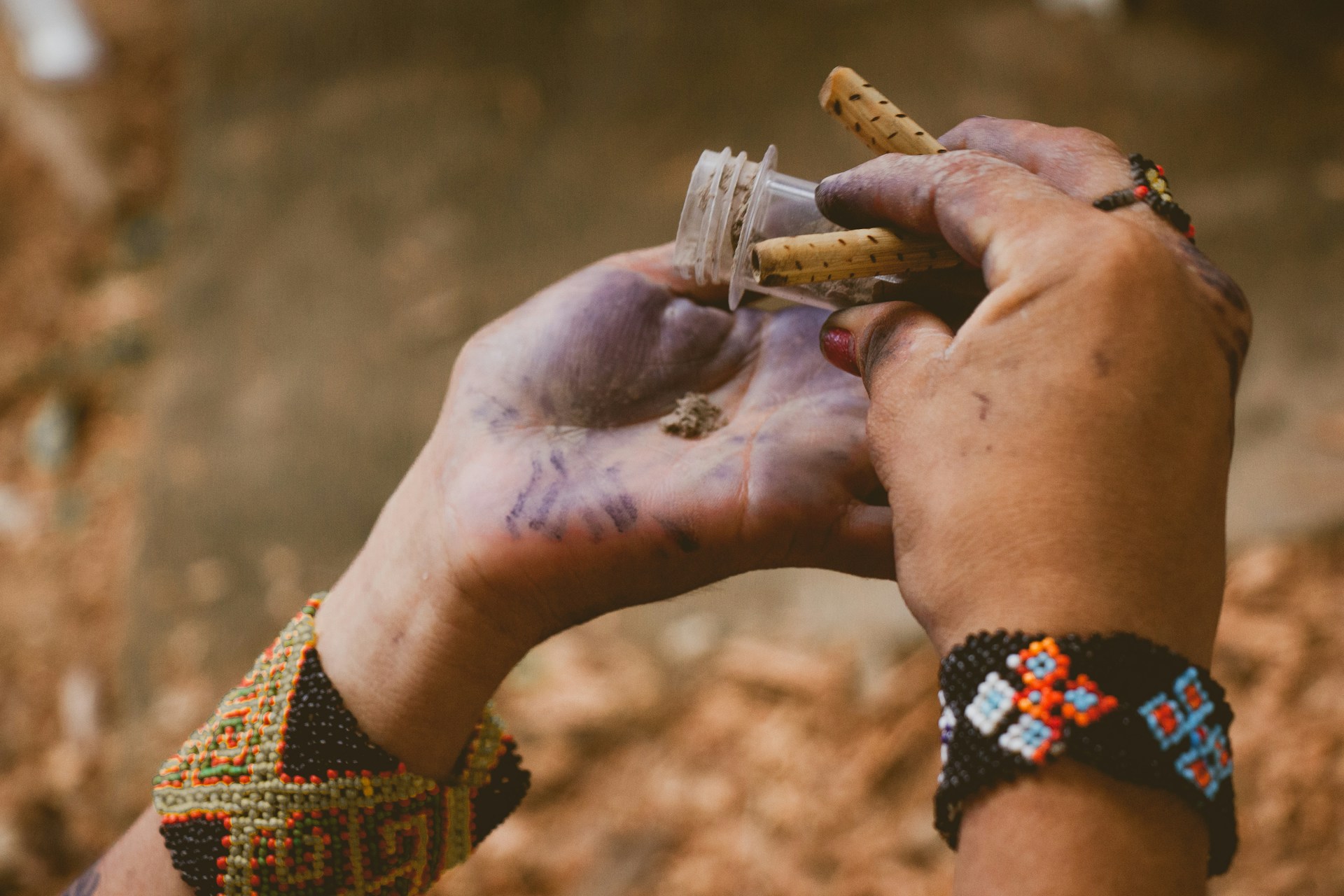
A kuripe is a small, V-shaped pipe, traditionally made from bamboo, hardwood, or bone, that Amazonian peoples such as the Yawanawá and Huni Kuin have long used to self-apply rapé (hapé) during ceremony. The key distinction is that the kuripe is a personal tool, with both ends held by the same person, while the longer, straight tepi is a serving tool that requires a second person. This guide to choosing the right kuripe for rituals treats the kuripe as a crafted object: how to judge its material, construction, and origin. Rapé and the tools around it are sold as ethnobotanical and ceremonial items. They are not for consumption, and nothing here is a usage instruction.
What is a kuripe, and how is it different from a tepi?
Both tools belong to the same ceremonial family, but they reflect two different social situations. The kuripe is short, usually somewhere between the length of a finger and a hand, and bent into a V or an L. In ethnographic descriptions, one end rests at the mouth and the other at the nostril of the same person, which is why it is often called a self-applicator.
The tepi is a straight tube, often 30 to 60 centimeters long, sometimes with a decorated mouthpiece. Among the Yawanawá and neighboring Pano-speaking peoples of Acre, Brazil, the tepi is associated with one person serving another, frequently an elder or experienced practitioner serving a participant. That relationship is part of its meaning: the tepi implies trust between two people, while the kuripe implies private, inward-facing ritual.
So the first question when choosing is not "which looks better" but "which object fits the context it belongs to." A collector building a respectful reference set may want both. Someone interested only in personal altar objects will usually be looking at kuripes.
Which Amazonian peoples make kuripes?
Most kuripes sold internationally today come from the western Brazilian Amazon, especially the state of Acre, and from border regions with Peru. Peoples whose craft and ceremonial traditions are linked with these tools include:
- Yawanawá: known for finely bound bamboo pieces and seed or bead decoration.
- Huni Kuin (Kaxinawá): famous for kene, geometric designs that also appear on textiles and body painting, sometimes carved or burned into wooden tools.
- Noke Koî (Katukina), Nukini, Shanenawa, and Kuntanawa: smaller communities whose pieces circulate through cooperatives and family networks.
- Matsés (Mayoruna): on the Peru and Brazil border, with their own long-documented applicator traditions.
Anthropologist Els Lagrou has shown that Huni Kuin designs are not decoration in the casual sense; they carry relationships to beings, plants, and stories. A kene pattern on a kuripe is therefore closer to a signature of a worldview than to a brand logo. When a seller cannot say which people or region a decorated piece comes from, that gap is worth noticing.
What materials are kuripes made from?
Bamboo
Bamboo is the most common material. Two thin sections are cut, angled, and joined, usually with cotton thread, natural resin, or beeswax. Bamboo is light and naturally hollow, which gives a smooth, even bore. Its weak point is the joint: if the seal dries out or cracks, the piece loses integrity. Good bamboo kuripes have a tight, even binding with no visible gaps.
Hardwood
Wooden kuripes are carved from a solid block or from two drilled pieces. They are heavier and more durable, and they offer room for carving: animal forms, kene lines, or burned patterns. The craft challenge is drilling a clean internal channel that meets at the angle without a sharp step inside. Wood selection varies by region, and responsible makers use timber from fallen trees or managed sources.
Bone
Historically, bird bone, including bones from large parrots and macaws, was used in parts of Amazonia because it is naturally hollow and strong. Today this deserves care. Many macaw species are listed in the CITES appendices, and Brazilian environmental law restricts trade in wild animal parts. Ethically, bone pieces on the international market should come with clear provenance, such as bones from domestic animals or documented legal sources. Without that, a wooden or bamboo piece is the more respectful choice.
Mixed pieces
Many contemporary kuripes combine materials: a bamboo body with a carved wooden joint, or wood with seed beads, feathers, or tucum palm fiber. These can be beautiful, but each added element is another point to check for quality and sourcing.
How can you tell a well-made kuripe from a weak one?
Even without handling a piece in person, product photos and descriptions reveal a lot. These are the features experienced buyers look at:
- The angle. Traditional pieces range from a sharp V to a gentle L. There is no single correct angle; it reflects the maker's lineage and the proportions of the piece. What matters is that both arms are straight and symmetrical.
- The bore. The internal channel should be smooth and continuous. Rough splinters or a visible step at the joint usually mean rushed work.
- The joint seal. On bamboo pieces, look for firm, even resin or wax and neat binding. Loose thread or brittle, flaking resin are warning signs.
- The finish of the ends. Both openings should be rounded and polished, never sharp or ragged.
- Proportion. A piece that is too long for its bore, or arms of very unequal length, often signals a decorative souvenir rather than a ceremonial object.
- Decoration that serves the piece. Beads and feathers should be firmly attached and should not obstruct either opening.
Choosing the right kuripe for rituals: a buyer's checklist
Pulling the threads together, here is how we think about selection when curating our own kuripe and tepi collection:
- Provenance first. Can the seller name the people, region, or cooperative? Is the maker credited? Named origin supports the communities whose knowledge shaped the tool.
- Material matched to purpose. Bamboo for a light, traditional piece; hardwood for durability and carved art; bone only with clear, legal sourcing.
- Construction quality. Clean bore, sealed joint, smoothed ends.
- Personal versus shared. A kuripe is by design a personal object. Many practitioners treat it as not to be lent, much like a personal ritual item.
- Aesthetic resonance. Once the practical points are met, choosing a piece whose form or pattern feels meaningful is a legitimate part of the process, as long as the pattern is understood as cultural, not generic.
One thing this checklist deliberately leaves out: advice about the body. We describe how Amazonian peoples have traditionally used these tools in their own contexts, but we do not give personal application instructions. Rapé is sold as a ceremonial and ethnobotanical item and is not for consumption.
How should a kuripe be stored and cared for?
Kuripes are organic objects, and most damage comes from moisture and neglect rather than wear. Sensible object care includes:
- Keeping it dry. Soaking a bamboo kuripe in water can soften resin or wax seals and loosen bindings. A dry, soft cloth or a thin, dry pipe cleaner keeps the channel clear.
- Storing it in a pouch. A cotton or woven pouch protects against dust, knocks, and direct sunlight, which can dry and crack bamboo.
- Avoiding heat and humidity swings. Windowsills, bathrooms, and car dashboards are hard on natural materials.
- Checking joints occasionally. If resin looks brittle, a piece is better retired to an altar or display than forced to keep serving.
- Light oiling for solid wood only. A very small amount of a neutral plant oil on the outer surface can keep carved wood from drying out. Bound joints are best left alone.
Why does respectful sourcing matter for a small tool?
A kuripe costs little compared to many ceremonial objects, which makes it easy to overlook where it came from. Yet these tools carry the knowledge of specific peoples, and international interest in rapé has created a market where mass-produced imitations sit beside authentic pieces. The Nagoya Protocol on access and benefit-sharing (2010) frames a broader principle that applies here in spirit: when traditional knowledge travels, benefits should travel back to the communities who hold it.
Practically, that means favoring pieces with named origins, avoiding wild-animal materials without documentation, and treating designs like kene as belonging to the people who made them. Choosing well is less about owning the most elaborate kuripe and more about holding an object whose story is honest.
If you would like to compare materials and lineages side by side, our kuripe, tepi, and ceremonial accessories page lists the origin of each piece we carry.
In shop practice, anchor the habit in concrete products: Rapé Kuntanawa Jatoba, Forest Pouch, forest incense. Compare labels in the same language and product form.
Sources
- Schultes, Richard Evans, and Robert F. Raffauf. The Healing Forest: Medicinal and Toxic Plants of the Northwest Amazonia. Dioscorides Press, 1990.
- Torres, Constantino Manuel, and David B. Repke. Anadenanthera: Visionary Plant of Ancient South America. Haworth Herbal Press, 2006. (Context on historical South American insufflation tools.)
- Lagrou, Els. A fluidez da forma: arte, alteridade e agência em uma sociedade amazônica (Kaxinawa, Acre). Topbooks, 2007.
- CITES Appendices I, II and III, Convention on International Trade in Endangered Species of Wild Fauna and Flora (current listings for Psittaciformes).
- Nagoya Protocol on Access to Genetic Resources and the Fair and Equitable Sharing of Benefits, Convention on Biological Diversity, 2010.